"Avising the Bright Beams" (Sir Thomas Wyatt, 1557)
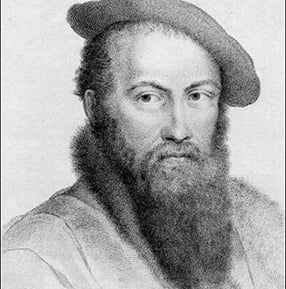 (image credit: https://poets.org/poet/thomas-wyatt)
About Sir Thomas Wyatt
"Sir Thomas Wyatt was born in 1503 at Allington Castle in Kent, England...He attended St. John's College, Cambridge, and married Elizabeth Brooke in 1520. Although she bore him two children, they separated shortly after marriage."
"Wyatt, like his father before him, worked in the court of Henry VIII...[where] he served first as esquire of the king's body and clerk of the king's jewels in 1524...By 1527, he began a diplomatic career with missions to France and Rome, where he grew acquainted with the French and Italian prosody that would later have profound influence on his literary life."
"Although Wyatt's poems circulated among many of the members of Henry's court, they did not appear in print until after his death...[his] poems, satires, and lyrics would remain in manuscript and slowly come into print during the nineteenth and twentieth centuries. Along with the Earl of Surrey, Wyatt is commonly credited with introducing the sonnet into English."
"Wyatt died of a fever on October 6, 1582, in Sherborne, Dorset."
To read more about Sir Thomas Wyatt and read some of his poems, refer to poets.org/poet/thomas-wyatt.
"Avising the Bright Beams" (Sir Thomas Wyatt, 1557)

Comments
Post a Comment